Abstract
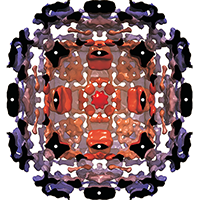
Magnetite, , is the first magnetic material discovered and utilized by mankind in Ancient Greece, yet it still attracts attention due to its puzzling properties. This is largely due to the quest for a full and coherent understanding of the Verwey transition that occurs at and is associated with a drop of electric conductivity and a complex structural phase transition. A recent detailed analysis of the structure, based on single crystal diffraction, suggests that the electron localization pattern contains linear three-Fe-site units, the so-called trimerons. Here, we show that whatever the electron localization pattern is, it partially survives up to room temperature as short-range correlations in the high-temperature cubic phase, easily discernible by diffuse scattering. Additionally, ab initio electronic structure calculations reveal that characteristic features in these diffuse scattering patterns can be correlated with the Fermi surface topology.
DOI: http://dx.doi.org/10.1103/PhysRevX.4.011040
- Published 17 March 2014
- Received 20 November 2013

Published by the American Physical Society under the terms of the Creative Commons Attribution 3.0 License. Further distribution of this work must maintain attribution to the author(s) and the published article’s title, journal citation, and DOI.
Published by the American Physical Society